
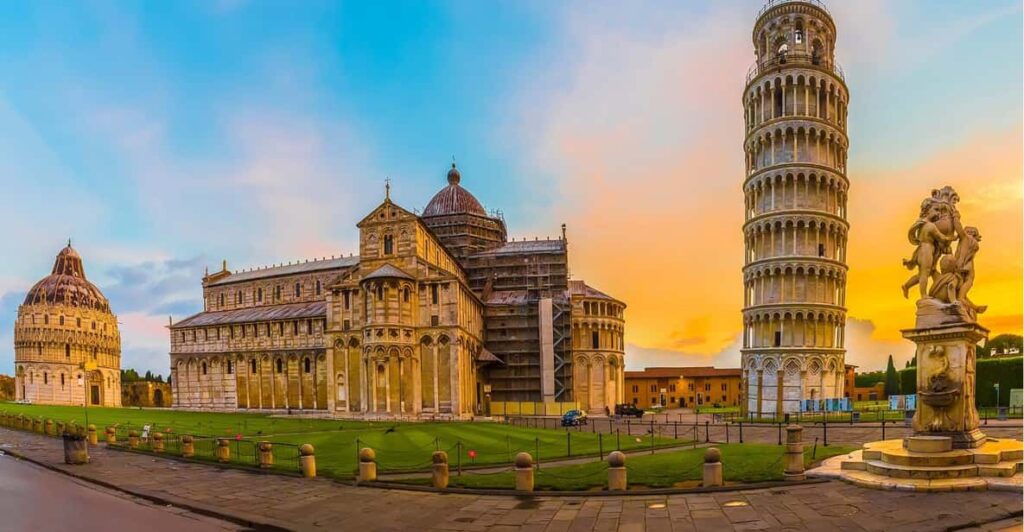
The Tower of Pisa is not just a monument—it is a living story where the past continues to breathe through marble and stone. Rising gracefully in the historic city of Pisa, Italy, this world-famous structure is instantly recognizable for its gentle lean and shining white exterior. For more than eight centuries, the Tower of Pisa has stood as a powerful symbol of history, resilience, and artistic brilliance. It is a place where time seems to slow, and where every visitor can feel the echoes of centuries gone by.
To stand before the Tower of Pisa is to connect with a remarkable past. What began as a bold medieval vision has become one of the most beloved landmarks on Earth. Its famous tilt, once feared as a failure, is now admired as the very feature that makes it unique.
A Vision from Medieval Pisa
Construction of the Tower of Pisa began in 1173, during a period when Pisa was one of the most powerful maritime republics in Italy. The city sought to express its wealth, devotion, and cultural strength through a grand religious complex. The tower was designed as the bell tower for the Cathedral of Santa Maria Assunta, located in the Piazza dei Miracoli, also known as the Square of Miracles.
Built from white and gray marble, the tower followed the Romanesque architectural style. Elegant arches, decorative columns, and detailed carvings reflected the artistic excellence of the time. The original plan was for a tall, perfectly straight structure that would stand proudly as a symbol of Pisa’s glory.
The Lean That Changed Destiny
Shortly after the first three levels were completed, builders noticed that the tower was beginning to lean. The soil beneath the foundation was soft and unstable, made of clay, sand, and silt. The heavy marble structure caused one side to sink.
Construction was halted for nearly 100 years, allowing the ground to settle. When work resumed, architects attempted to correct the lean by adjusting the design of the upper floors. Instead of fixing the problem, they created the tower’s graceful curve, making the lean even more noticeable. Over time, what was once a flaw became the tower’s defining feature.
A Masterpiece of Marble
The Tower of Pisa stands approximately 56 meters tall and consists of eight levels, including the bell chamber at the top. Each level is decorated with elegant arches and columns that reflect the Romanesque style. The white marble exterior glows under the Tuscan sun, creating a magical sight against the blue sky.
Inside, a spiral staircase with nearly 300 steps leads to the summit. As visitors climb, they can feel the gentle tilt beneath their feet, making the journey exciting and unforgettable. At the top, breathtaking views of Pisa, the Arno River, and the surrounding countryside await.
Engineering That Preserved History
By the late 20th century, the tower’s lean had become dangerous. In 1990, it was closed for restoration. Engineers from around the world worked together to stabilize the structure.
They carefully removed soil from beneath the higher side and reinforced the foundation, reducing the tilt and securing the tower for future generations.
A Place of Legend
The Tower of Pisa is associated with Galileo Galilei, who was born in Pisa. According to legend, he conducted gravity experiments from the tower.
A Living Past
Today, the Tower of Pisa remains one of the world’s greatest treasures. It is a place where the past lives, inspiring millions with its beauty, history, and timeless spirit.