
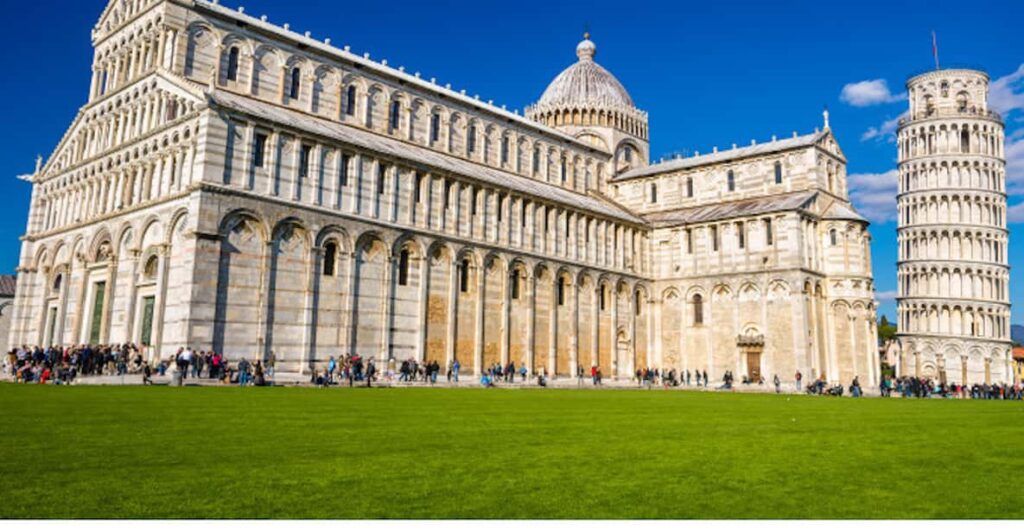
The Tower of Pisa is not just a monument—it is beauty in motion, a living symbol of history, art, and human resilience. Famous for its gentle lean and radiant white marble, this iconic structure has fascinated the world for more than eight centuries. Rising in the heart of Pisa, Italy, the tower appears to move even while standing still, as if frozen in a graceful dance with gravity. What began as a simple architectural project has become one of the most admired landmarks on Earth.
To witness the Tower of Pisa is to see beauty that feels alive. Its tilt, once feared as a fatal flaw, is now celebrated as a sign of uniqueness and charm. The tower’s “motion” tells a story of time, struggle, and survival.
A Dream Born in Medieval Pisa
Construction of the Tower of Pisa began in 1173, during the height of Pisa’s power as a maritime republic. The city sought to display its wealth, faith, and artistic brilliance by building a grand bell tower for the Cathedral of Santa Maria Assunta. This sacred complex, located in the Piazza dei Miracoli (Square of Miracles), also includes the Baptistery and Camposanto, forming one of the most beautiful religious sites in the world.
The tower was designed in the Romanesque style and built from white and gray marble. Its elegant arches, decorative columns, and carved details reflected the craftsmanship of medieval Italy. The original plan was for a tall, straight structure that would rise proudly above the city.
The Lean That Changed Everything
Shortly after the first three levels were completed, builders noticed the tower was beginning to lean. The soft soil beneath the foundation—made of clay, sand, and silt—could not support the heavy marble structure. One side began to sink, creating the famous tilt.
Construction was halted for nearly 100 years. When work resumed, architects attempted to correct the lean by adjusting the upper floors. Instead, they created the tower’s signature curve, giving it the appearance of graceful motion.
A Masterpiece of Marble
The Tower of Pisa stands approximately 56 meters tall and consists of eight levels, including the bell chamber. Each level is decorated with elegant arches and columns that reflect the Romanesque style. The marble exterior glows under the Tuscan sun, making the tower shimmer like a living sculpture.
Inside, a spiral staircase with nearly 300 steps leads visitors upward. As you climb, you can feel the gentle tilt beneath your feet, adding to the sense that the tower is alive. At the top, breathtaking views of Pisa and the countryside await.
Engineering the Impossible
By the late 20th century, the lean had become dangerous. Engineers stabilized the tower by removing soil from beneath the higher side and reinforcing the foundation. These efforts preserved its tilt while ensuring safety.
A Living Symbol
The Tower of Pisa continues to inspire the world as beauty in motion—standing, leaning, and living through history.