
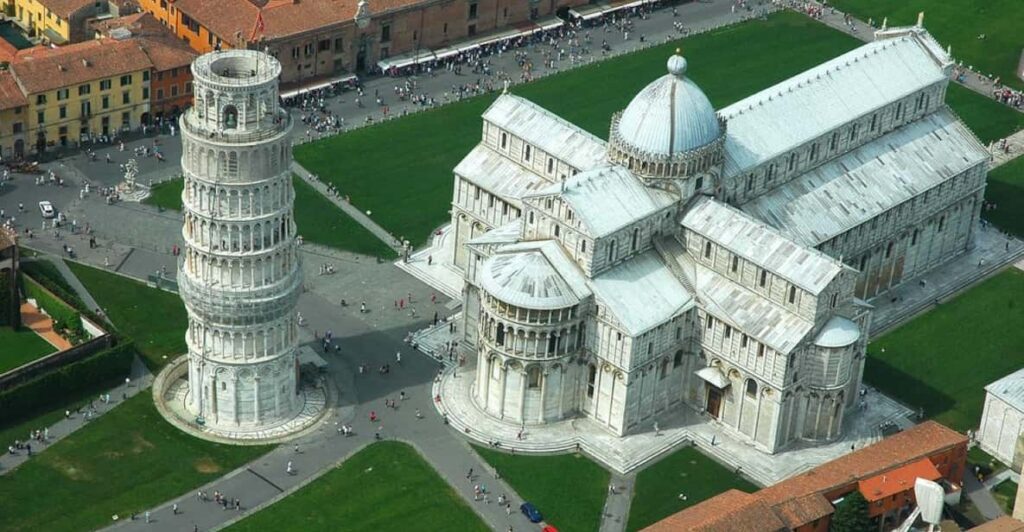
The Leaning Tower of Pisa is one of the most recognizable monuments in the world, famous for its dramatic tilt. While many people enjoy taking photos pretending to hold it up, few understand the science behind its lean angle. The tilt is not just a visual trick—it is the result of complex interactions between soil, gravity, architecture, and centuries of engineering efforts. Understanding the tower’s lean angle helps explain why it leans, how it has changed over time, and why it has not fallen.
What Is the Lean Angle?
The lean angle refers to how far the tower tilts from a perfectly vertical position. When the tower was first built in the 12th century, it was meant to stand straight. However, due to weak soil and a shallow foundation, it began to lean almost immediately.
At its most extreme point in the late 20th century, the tower leaned at about 5.5 degrees. This meant that the top of the tower was displaced by nearly 4.5 meters (15 feet) from its original centerline.
After major stabilization work in the 1990s and early 2000s, the lean was reduced slightly. Today, the tower leans at about 3.97 degrees, making it safer while still visibly tilted.
Why Did the Angle Increase?
The lean angle increased because the soil beneath one side of the foundation compressed more than the other. As gravity pulled the tower downward, its center of mass shifted outward, increasing pressure on the sinking side. This created a slow, continuous movement known as creep, which gradually increased the angle.
Construction Errors
The foundation was only three meters deep and built on soft soil made of clay, sand, and shells. Medieval builders did not understand how soil behaves under heavy loads, which allowed the tilt to worsen.
Attempts to Correct the Angle
Builders tried to correct the lean by making upper floors taller on one side. Later attempts, such as digging around the base, sometimes made the tilt worse.
Modern Stabilization
Engineers used soil extraction and counterweights to reduce the angle safely.
Why It Has Not Fallen
The tower remains standing because its center of gravity still lies within its base.
Conclusion
The lean angle of the Tower of Pisa is a result of history, science, and engineering. What began as a mistake has become a global wonder.
If you’d like, I can add diagrams, simplify, or turn this into a presentation.