
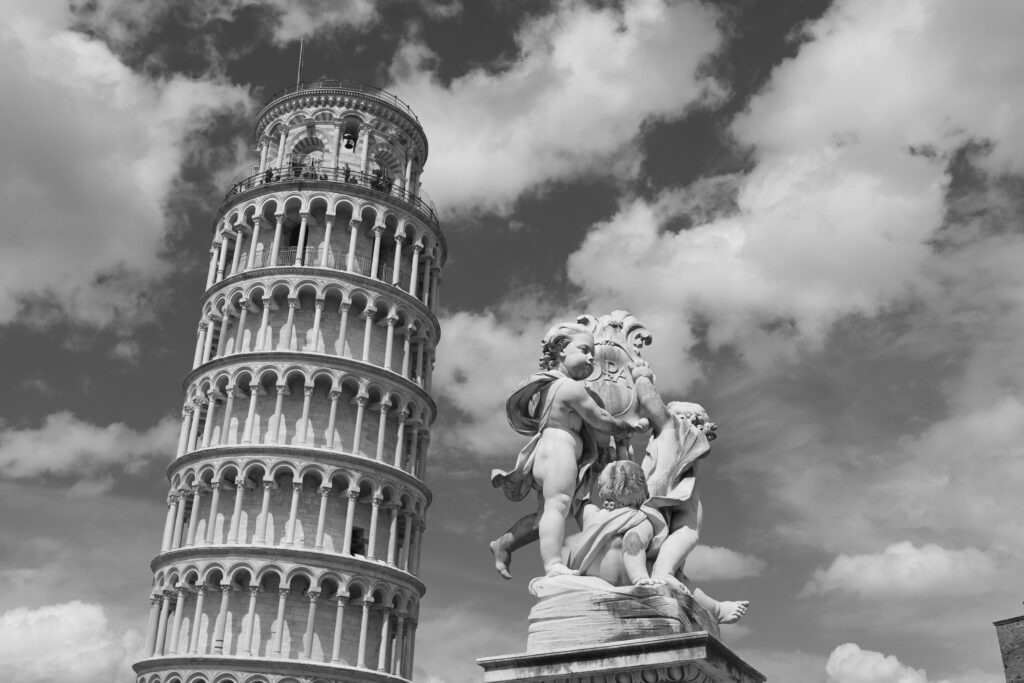
The Leaning Tower of Pisa is one of the most recognizable buildings in the world. Located in Pisa, Italy, the tower is famous not because of its height or beauty alone, but because it leans at a dramatic angle. Millions of tourists visit every year to see the tower that appears as if it might fall at any moment. But the tower was never meant to lean. Its tilt is the result of a combination of poor planning, weak soil, and centuries of human attempts to correct the problem. The story of why the Tower of Pisa leans is a fascinating lesson in engineering, geology, and history.
A Tower Built on Weak Ground
The main reason the Tower of Pisa leans is because it was built on unstable soil. When construction began in 1173, builders laid the foundation on soft ground made of clay, sand, and silt. This type of soil is very compressible and cannot support heavy structures well. The foundation of the tower was only about three meters deep, which was far too shallow for a stone tower of such size and weight.
The tower weighs more than 14,000 tons, and the ground beneath it could not support this load evenly. As a result, the soil on one side compressed more than the other, causing the tower to tilt.
The First Signs of Trouble
The leaning began while the tower was still under construction. After the first three floors were completed, workers noticed that the building was sinking on one side. The tilt became obvious by 1178, just five years after construction started. At that time, there was no modern knowledge of soil mechanics or structural engineering, so the builders did not fully understand what was happening.
Instead of rebuilding the foundation, they stopped construction, hoping the ground would settle. This pause lasted nearly 100 years because of wars involving Pisa. Ironically, this delay helped prevent the tower from collapsing, as the soil had time to compress and stabilize.
Attempts to Correct the Lean
When construction resumed in the late 13th century, builders tried to compensate for the tilt by making the upper floors taller on the sinking side. This caused the tower to curve slightly. Although this made the tower appear straighter, it also shifted the weight unevenly and added stress to the structure.
Over the centuries, several attempts were made to stop or reduce the lean. Some of these efforts made the situation worse. In the 19th century, for example, workers tried to dig around the base to make the tower visible, but this caused more soil to shift, increasing the tilt.
The Role of Gravity
Gravity also plays a key role. As the tower leaned, its center of mass shifted farther from the center of its foundation. The more it leaned, the more gravity pulled it downward on the sinking side. This created a slow, continuous movement called creep, which gradually increased the angle over time.
By the late 20th century, the tower was leaning at more than 5 degrees, which meant the top of the tower was about 4 meters away from its original vertical position.
Soil and Water Effects
The soil under Pisa is not only soft but also affected by underground water. Changes in the water table cause the soil to expand or shrink, making the tower move slightly each year. Heavy rainfall or dry seasons can increase this effect, slowly changing the angle of the lean.
Modern Engineering Solutions
By 1990, the tilt had become dangerous, and the tower was closed to visitors. A team of international engineers worked for over a decade to save it. They used a technique called soil extraction, where small amounts of soil were carefully removed from under the higher side of the foundation. This allowed the tower to settle back slightly.
They also used steel cables and lead counterweights to support the structure during the work. These methods successfully reduced the lean by about 45 centimeters and stabilized the tower.
A Symbol of Imperfection
The Tower of Pisa leans because of a combination of poor foundation design, weak soil, gravity, and centuries of human intervention. Yet, instead of being a failure, it has become a symbol of resilience and creativity. Today, it stands safely, reminding us that even mistakes can become wonders.