
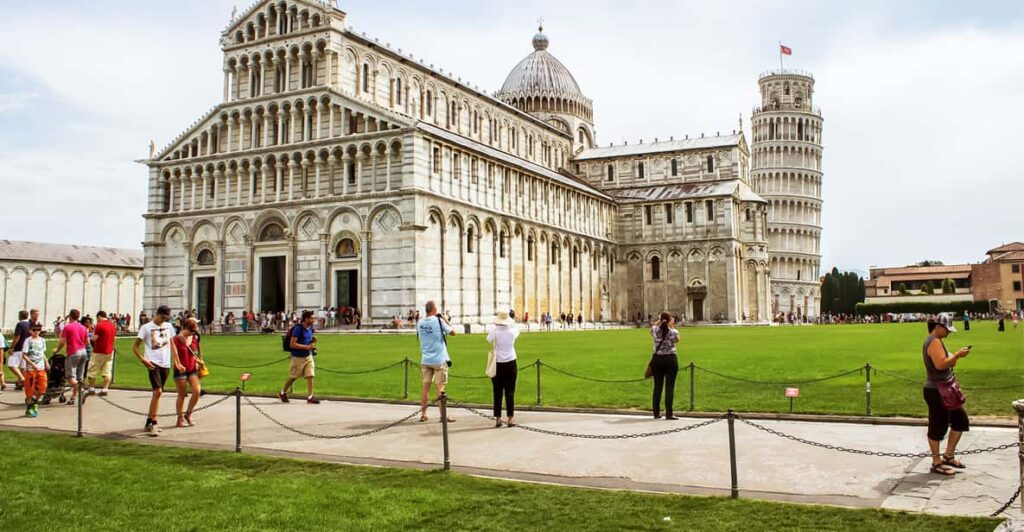
The Leaning Tower of Pisa is one of the most famous landmarks in the world. While millions recognize it for its dramatic tilt, far fewer people know the full story of who actually built it. Unlike modern buildings that are usually designed and completed by a single architect or firm, the Tower of Pisa was constructed over nearly 200 years and involved several architects, engineers, and craftsmen. Because of this long timeline and multiple interruptions, there is no single “builder” of the tower. Instead, the Leaning Tower is the result of the work of several generations of Pisan architects.
The Historical Setting
Construction of the tower began in 1173, when Pisa was a powerful maritime republic. The city was wealthy from trade and wanted monuments that reflected its religious devotion and political importance. The tower was designed as the bell tower (campanile) for the Cathedral of Santa Maria Assunta in the Piazza dei Miracoli.
The project was part of a larger architectural complex that included the cathedral and baptistery. The tower was meant to be a symbol of Pisa’s greatness and faith.
Bonanno Pisano – The First Architect
The earliest and most commonly credited architect of the Leaning Tower is Bonanno Pisano, a sculptor and architect from Pisa. His name appears on a stone inscription discovered in the 19th century, which many historians interpret as evidence of his involvement in the original design.
Bonanno began the project in 1173 and completed the foundation and first three floors. His design followed the Romanesque style, using white marble, rounded arches, and decorative columns.
However, Bonanno did not realize that the soil beneath the tower was unstable. By the time the third floor was completed, the tower had already begun to lean. Construction was stopped, and Bonanno likely left Pisa or died soon after.
Guglielmo di Innsbruck – Co-Designer
Some historians believe that Guglielmo di Innsbruck worked alongside Bonanno Pisano during the first stage of construction. While records are limited, his name appears in historical documents connected to the cathedral complex.
It is possible that both men contributed to the original design and layout of the tower.
Giovanni di Simone – The Engineer Who Tried to Fix It
After nearly 100 years of silence, construction resumed in 1272 under Giovanni di Simone. He was tasked with continuing the tower despite its dangerous lean.
Giovanni attempted to correct the tilt by building the upper floors slightly taller on the sinking side. This created the tower’s famous curved shape. During his leadership, three more floors were added.
Unfortunately, the lean continued to worsen, and construction stopped again after Pisa was defeated in war in 1284.
Tommaso di Andrea Pisano – The Final Builder
The tower was finally completed in 1372 by Tommaso di Andrea Pisano, the son of famous sculptor Andrea Pisano. He designed and built the bell chamber at the top.
Tommaso carefully aligned the bell chamber to reduce stress on the leaning structure, completing the tower’s iconic silhouette.
Craftsmen and Laborers
Behind these architects were hundreds of stone masons, builders, and laborers who shaped and placed the heavy marble blocks. Their skills allowed the tower to survive centuries of movement.
A Monument Built by Generations
The Leaning Tower of Pisa was not built by one man, but by many hands across two centuries. Each architect faced challenges and left a mark on the tower’s story. Together, they created one of the world’s greatest wonders.