
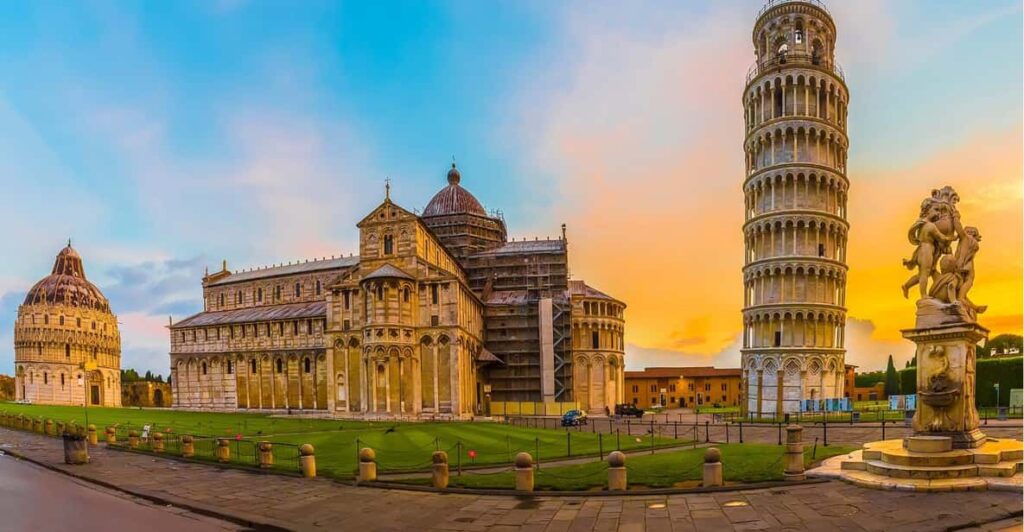
The Leaning Tower of Pisa is one of the most famous monuments in the world. Located in the city of Pisa, Italy, it is best known for its unintended tilt, which makes it appear as though it is about to fall. Despite this flaw, the tower has stood for more than eight centuries and has become a symbol of architectural beauty, human error, and engineering perseverance. Its long history reflects the political, cultural, and scientific development of medieval and modern Europe.
Origins of the Tower
The Leaning Tower of Pisa was built as the bell tower (campanile) of the Cathedral of Santa Maria Assunta, part of a religious complex known as the Piazza dei Miracoli (Square of Miracles). Construction began in 1173, during a period when Pisa was a powerful maritime republic. The city was wealthy from trade and wanted monuments that showed its status and religious devotion.
The original architect is still debated, but many historians believe the design was by Bonanno Pisano or Guglielmo di Innsbruck. The tower was planned to be straight and vertical, but the builders unknowingly laid the foundation on soft, unstable soil made of clay, sand, and shells. The foundation was only about three meters deep, far too shallow for such a heavy stone structure.
The Beginning of the Lean
After the first three floors were completed around 1178, workers noticed that the tower had begun to lean toward the south. The ground beneath one side of the foundation was sinking faster than the other. This created the tilt that the tower is famous for today.
Construction was halted for nearly 100 years because of wars between Pisa and neighboring city-states such as Genoa, Lucca, and Florence. Surprisingly, this delay helped prevent the tower from collapsing. During this time, the soil had time to settle and compact, giving the structure more stability.
Continued Construction and Design Changes
Work resumed in 1272 under the architect Giovanni di Simone. To compensate for the tilt, builders made the upper floors slightly taller on the leaning side. This gave the tower a curved shape, often described as a “banana shape.”
Three more stories were added before construction stopped again due to military defeat in 1284. Finally, in 1372, the tower was completed with the addition of the bell chamber, designed by Tommaso di Andrea Pisano.
The tower reached a height of about 56 meters (183 feet) on the taller side and 54.7 meters (179 feet) on the lower side. It contains 294 steps leading to the top.
The Bells of the Tower
The Leaning Tower houses seven bells, each corresponding to a musical note. The largest bell, called L’Assunta, was cast in 1655 and weighs over 3.5 tons. For many years, the bells were not rung because their vibrations might have worsened the tilt. Today, they are rung only on special occasions.
Scientific Importance
The tower is also associated with the famous scientist Galileo Galilei, who was born in Pisa in 1564. According to legend, Galileo dropped two spheres of different weights from the top of the tower to prove that objects fall at the same speed regardless of mass. Although historians debate whether this experiment truly happened, the story has made the tower a symbol of scientific discovery.
Attempts to Save the Tower
By the 20th century, the tilt had become dangerous. The tower leaned more than 5 degrees, and experts feared it might collapse. In 1990, the tower was closed to the public for safety reasons.
An international team of engineers began a massive restoration project. They used several methods, including:
- Removing soil from under the higher side
- Installing steel cables to hold the tower
- Adding counterweights made of lead
After 11 years of work, the tilt was reduced by about 45 centimeters, and the tower was stabilized. In 2001, it was reopened to visitors.
A UNESCO World Heritage Site
In 1987, the Leaning Tower of Pisa, along with the surrounding cathedral complex, was declared a UNESCO World Heritage Site. It is considered one of the finest examples of Romanesque architecture in Europe and attracts millions of tourists each year.
Cultural Symbol
Today, the Leaning Tower is more than just a building—it is a global icon. It represents how mistakes can become masterpieces and how human creativity and determination can preserve history. Visitors from around the world take photos pretending to “hold up” the tower, celebrating its unique charm.
Conclusion
The Leaning Tower of Pisa is a remarkable blend of history, architecture, science, and culture. What began as a construction error has become one of the most beloved monuments on Earth. Standing for over 800 years, the tower reminds us that even imperfect creations can achieve greatness and inspire generations.