
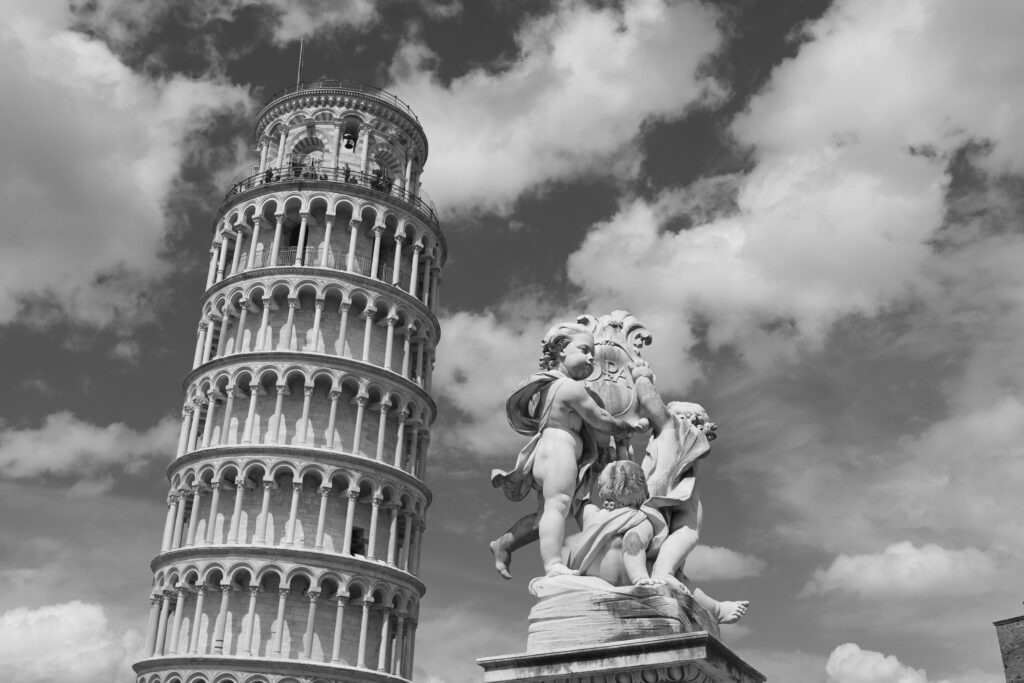
The Leaning Tower of Pisa is not only famous for its dramatic tilt but also for its connection to one of the greatest scientists in history—Galileo Galilei. For centuries, a popular story has claimed that Galileo climbed to the top of the tower and dropped two objects of different weights to prove that they would hit the ground at the same time. This dramatic experiment is said to have challenged the ancient belief that heavier objects fall faster than lighter ones.
But did this legendary experiment really happen? Or is it just a myth that grew over time? To answer this question, we must explore Galileo’s life, his scientific ideas, and the historical evidence behind the story.
Galileo and Pisa
Galileo Galilei was born in 1564 in Pisa, Italy. As a young man, he studied at the University of Pisa and later became a professor of mathematics there. During this period, Galileo became interested in motion, gravity, and the laws of nature.
At the time, most scholars followed the ideas of the ancient Greek philosopher Aristotle, who believed that heavier objects fall faster than lighter ones. Galileo doubted this and began to conduct experiments to test the truth.
The Famous Story
According to legend, Galileo climbed the Leaning Tower of Pisa and dropped two balls of different weights at the same time. When both hit the ground together, he supposedly proved Aristotle wrong in front of a crowd of shocked professors and students.
This dramatic image has become one of the most famous stories in the history of science.
Is There Proof?
Despite the popularity of the story, no solid historical records from Galileo’s lifetime confirm that the experiment took place. Galileo himself never mentioned it in his writings. The first written account appeared many years later, in a biography written by one of his students.
Because of this, many historians believe the story is symbolic rather than factual—a way to illustrate Galileo’s revolutionary ideas.
What Galileo Really Did
Even if he didn’t drop objects from the tower, Galileo did perform careful experiments with inclined planes, rolling balls down slopes to measure speed and time. These experiments helped him discover that all objects fall at the same rate, regardless of weight (ignoring air resistance).
Why the Tower Is Linked to Galileo
The Tower of Pisa represents Galileo’s challenge to old beliefs. The story connects a famous place with a famous thinker, making the lesson easy to remember.
Conclusion
There is no clear evidence that Galileo used the Tower of Pisa for his experiments. However, the story reflects the spirit of his work—questioning tradition and using observation to discover the truth. Whether real or symbolic, the legend continues to inspire curiosity and scientific thinking.
If you’d like, I can write:
- Galileo’s most important discoveries
- Science myths and legends
- Famous historical experiments explained